
DEATH VALLEY RUNNING CAMP
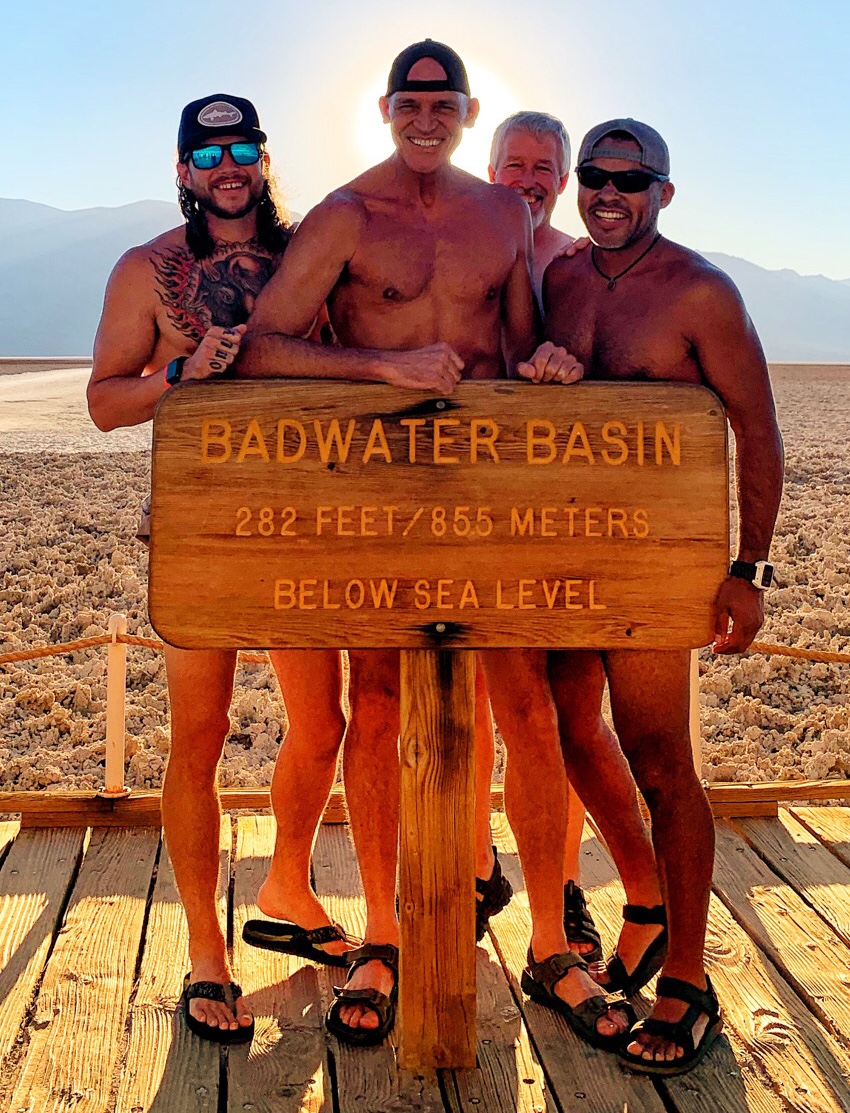
IT ALL STARTED WITH A PHOTO...
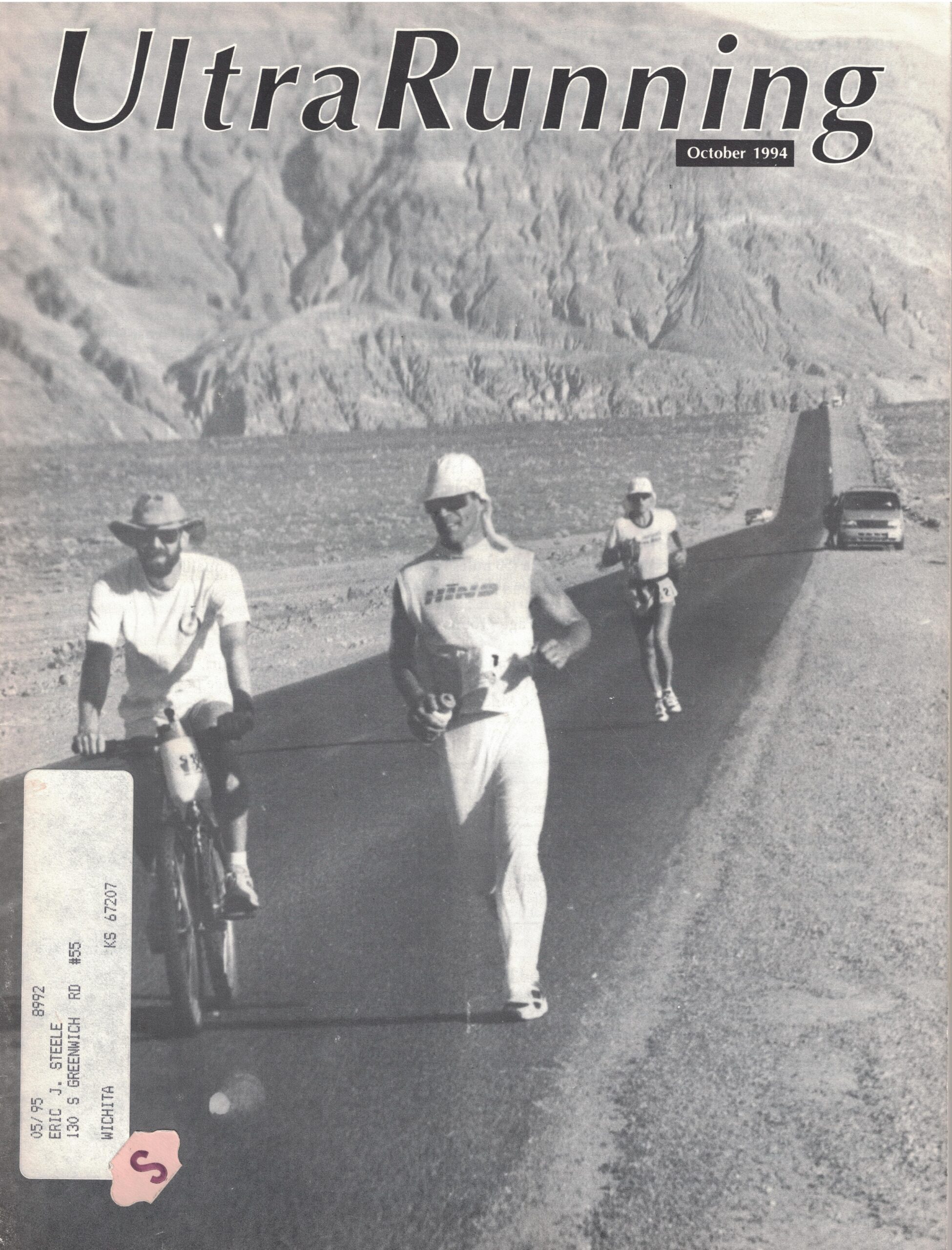
...OR A STORY, OR A NAME.
At some point, every serious ultrarunner hears about Death Valley.
Maybe it was seeing Marshall Ulrich running across the desert on the cover of UltraRunning magazine, one of many Badwater finishes in a career no one has ever come close to matching. Maybe it was reading about runners crossing the lowest point in North America, in the heat, on open roads, with nothing but their crew and their decisions holding it together.
Maybe it was the first time you heard the words Badwater 135 and thought, “That’s insane.” And then quietly followed it with, “But what if…”
For some, that curiosity turns into years of watching. Studying splits. Reading race reports. Learning the towns. Learning the climbs. Understanding the course without ever setting foot on it.
Maybe you’ve applied. Maybe you’ve crewed. Maybe you know you’re close…or at least closer than you used to be.
What most runners discover and learn pretty quickly is this:
Death Valley isn’t just hard. It’s complicated.
AND THEN REALITY SETS IN...
You start looking at what it actually takes to be out there. Not just the miles, but everything around them. You realize you need a crew. A vehicle that can survive the desert. Lodging spread across multiple towns. Time off work. Friends or family willing to give up nearly a week of their lives in extreme heat…often without fully understanding what they’re signing up for.
You learn that most rental car companies in Las Vegas don’t even allow their vehicles in Death Valley. You discover that the logistics alone can cost as much as the race itself, if that's your ultimate goal, and you quickly understand that trying to train on the course beforehand feels almost impossible.
The dream is still there. But now it’s buried under logistics, cost, and coordination.
And that leads to a different question.

WHAT IF IT WERE THAT SIMPLE?
What if you didn’t have to convince a friend or family member to crew you across Death Valley?
What if you didn’t have to string together four towns, rent a questionable vehicle, or gamble on logistics you’ve never actually tested?
What if you could show up in Las Vegas, get picked up, and be taken deep into Death Valley by someone who has already made the mistakes you’re trying to avoid?
What if you could run the actual Badwater course, from Badwater Basin to Whitney Portal, not racing, not chasing cutoffs, but learning how the desert really works?
Not under pressure.
Not in competition.
Not pretending this is something it’s not.
Just seven runners. One course. One environment. And the chance to finally understand Death Valley from the inside.
That question is exactly why the Death Valley Running Camp exists.

INTRODUCING THE DEATH VALLEY RUNNING CAMP
An immersive, small-group experience on the actual Badwater course!
Death Valley is not a place you dabble.
It exposes weaknesses quickly…in training, pacing, fueling, decision-making, and mindset. There is nowhere to hide, and no margin for error. Every assumption eventually gets tested.
The Death Valley Running Camp is a fully immersive, small-group experience conducted on the actual Badwater 135 race course, from Badwater Basin to the base of Mount Whitney. This is not preparation by proxy. This is learning on the course where it actually all lives.
Every mile matters. Every mistake shows up. And every lesson is learned on the road, not in theory.
This is not a classroom. It is not a sightseeing tour. And it is not a simulation.
Over multiple days, you will move across the same pavement, the same climbs, and the same brutal stretches that define the Badwater course, while staying in the same towns and locations runners encounter along the way. You experience Death Valley as it truly is…the heat, the exposure, the isolation, and the logistics required to move through it intelligently.
You are not guessing. You are not imagining. You are living it.
This camp exists for athletes who want to understand Death Valley from the inside out, whether their goal is Badwater itself or simply mastering one of the most unforgiving endurance environments on Earth.
Small groups of seven. No shortcuts. No filters.
This is Death Valley…fully understood, not imagined.
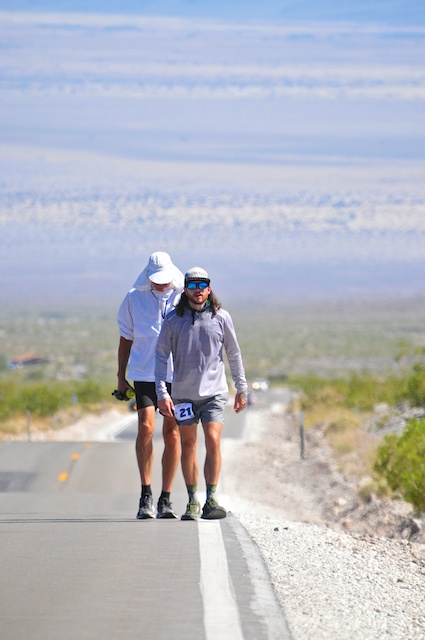
WHAT THIS ACTUALLY IS
This is not a race. There are no cutoff times, no competition, and no pressure to perform.
This is a small-group (7 max), fully immersive Death Valley training camp run on the actual Badwater course, designed to teach you how the desert really works.
You will move forward at your pace. You will learn in real conditions. You will make decisions, adjust, recover, and adapt with guidance from someone who has already lived the consequences.
All days will be long. Many miles will be uncomfortable. None of this is accidental.
This camp is about understanding heat, pacing, fueling, crewing, recovery, and decision-making under stress. Not in theory, but in the actual Valley itself.
HOW THE CAMP IS STRUCTURED
This camp is intentionally small. Seven runners. One course. One roving crew vehicle.
Each camp runs point-to-point across the actual Badwater course, from Badwater Basin to Whitney Portal. We do not run a section and drive back somewhere else. We stay where the course takes us, and every day builds on the last.
You will run in real heat, on real pavement, with real consequences if decisions are wrong.
Support is consistent but not intrusive and is provided by Badwater veteran, Eric Steele, an ultrarunner who has already lived the consequences, operating a roving crew vehicle that leapfrogs the group to provide essentials access, water/ice, guidance, problem-solving, and oversight, while still allowing runners the freedom to move at their own pace.
This is not babysitting, and it is not survival-of-the-fittest.
Runners are loosely grouped by ability and experience, and running in pairs is strongly encouraged. Stopping is always an option. If you need to pull the plug for the day, you can. If you need to adjust pace, strategy, or expectations, you will.
The goal is not to push through at all costs. The goal is to understand what works, what doesn’t, and why.
By the end of camp, you won’t just know the course. You will better understand how to move through it.

THE ROUTE
From the Lowest Point to the Highest Finish
This is a point-to-point crossing of Death Valley and the Eastern Sierra, beginning below sea level and finishing at the gates of Mount Whitney. The route follows paved roads the entire way, but make no mistake...the environment does not care that the surface is smooth.
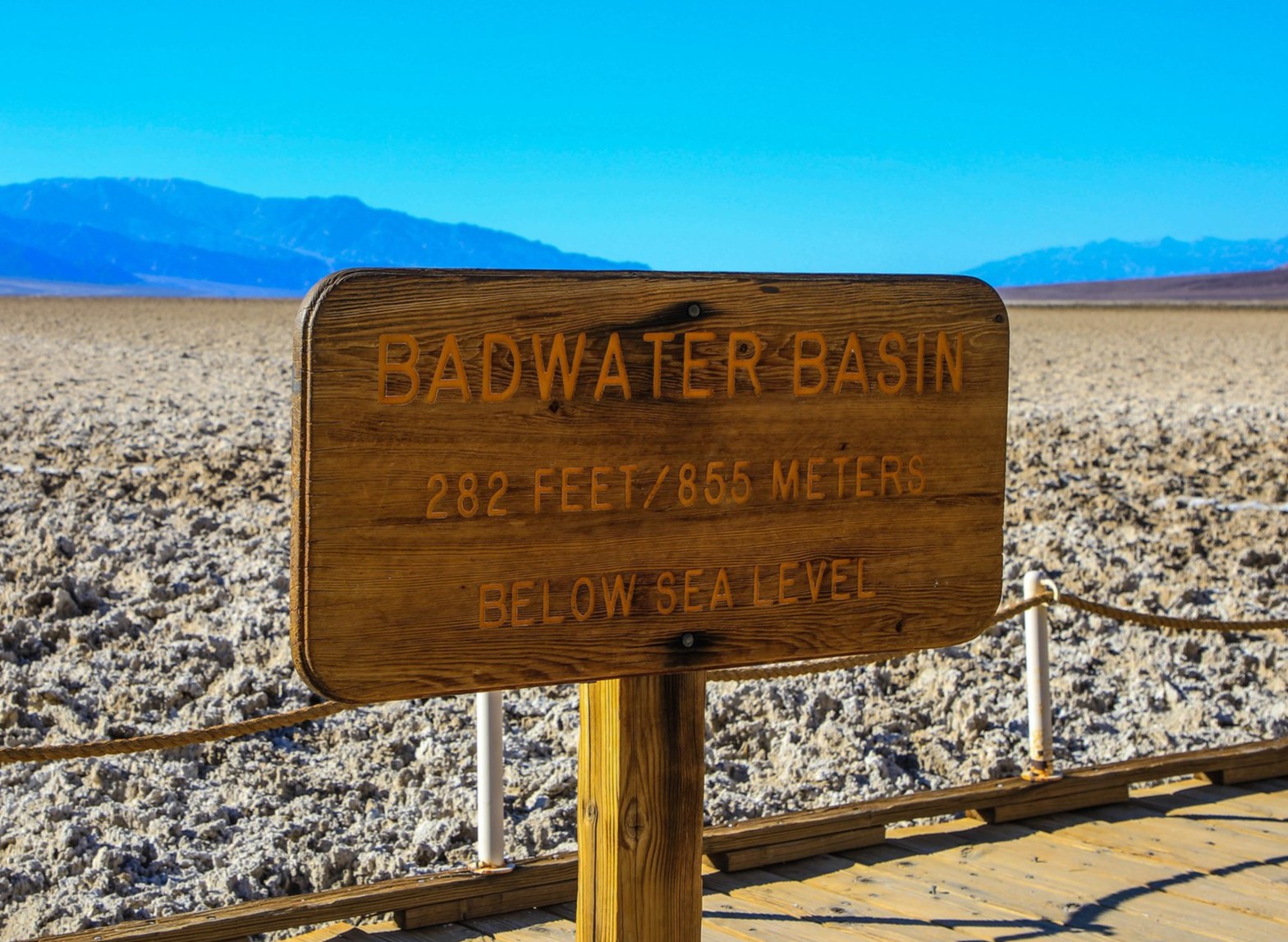
Badwater Basin → Stovepipe Wells (42.2 miles)
The journey begins at Badwater Basin, the lowest point in North America. Early miles are deceptively runnable, rolling across the valley floor before gradually trending north on CA-190. Heat, exposure, and relentless reflection off the valley floor set the tone early.
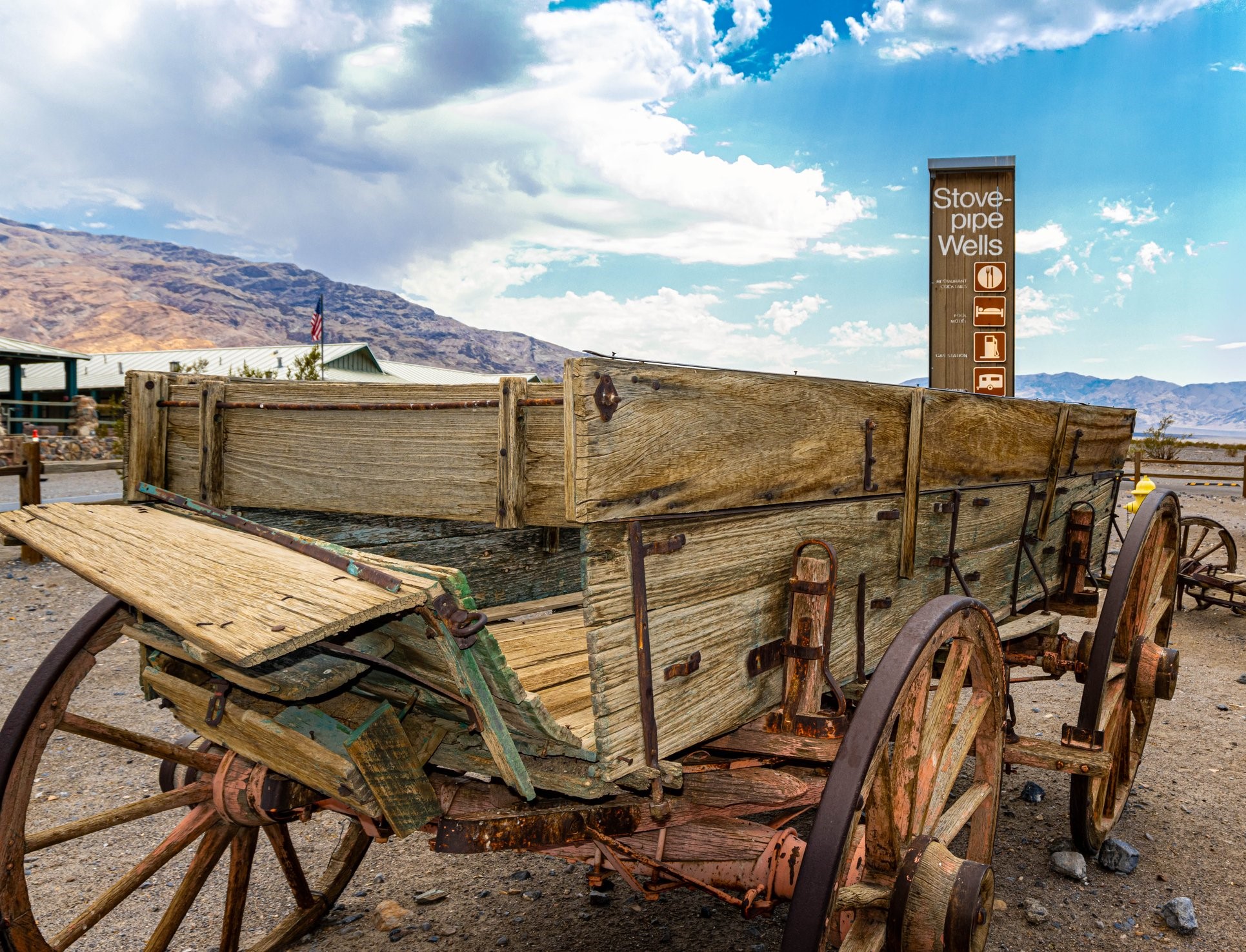
Stovepipe Wells → Panamint Springs (30.6 miles)
This is where the course shows its teeth. Long, sustained climbing dominates this segment, with more than 5,000 feet of elevation gain. Temperatures can still be brutal, and visual progress is minimal. Patience here is not optional…it’s survival.
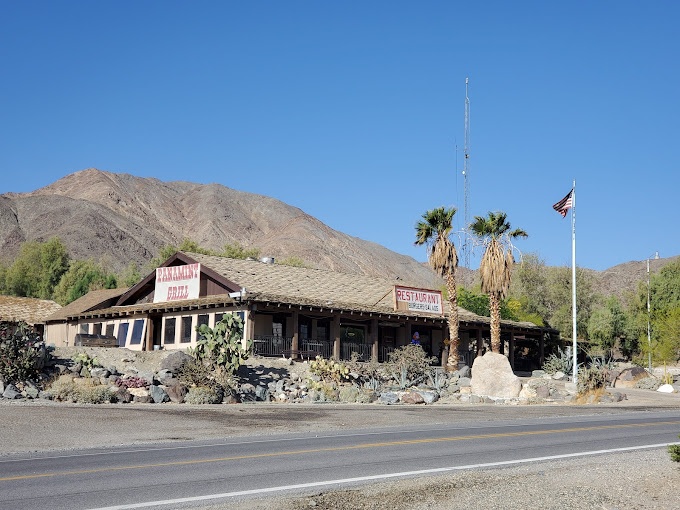
Panamint Springs → Lone Pine (50.0 miles)
The longest segment of the route. Big miles, wide-open desert, and extended isolation define this stretch. While the elevation profile looks manageable on paper, cumulative fatigue and exposure turn this into a mental grind far more than a physical one.
Lone Pine → Whitney Portal (11.3 miles)
The final test. After more than 120 miles on foot, runners begin the relentless climb to Whitney Portal. Over 4,000 feet of gain in just over eleven miles, at altitude, with nothing left to hide behind. The finish is earned…not given.
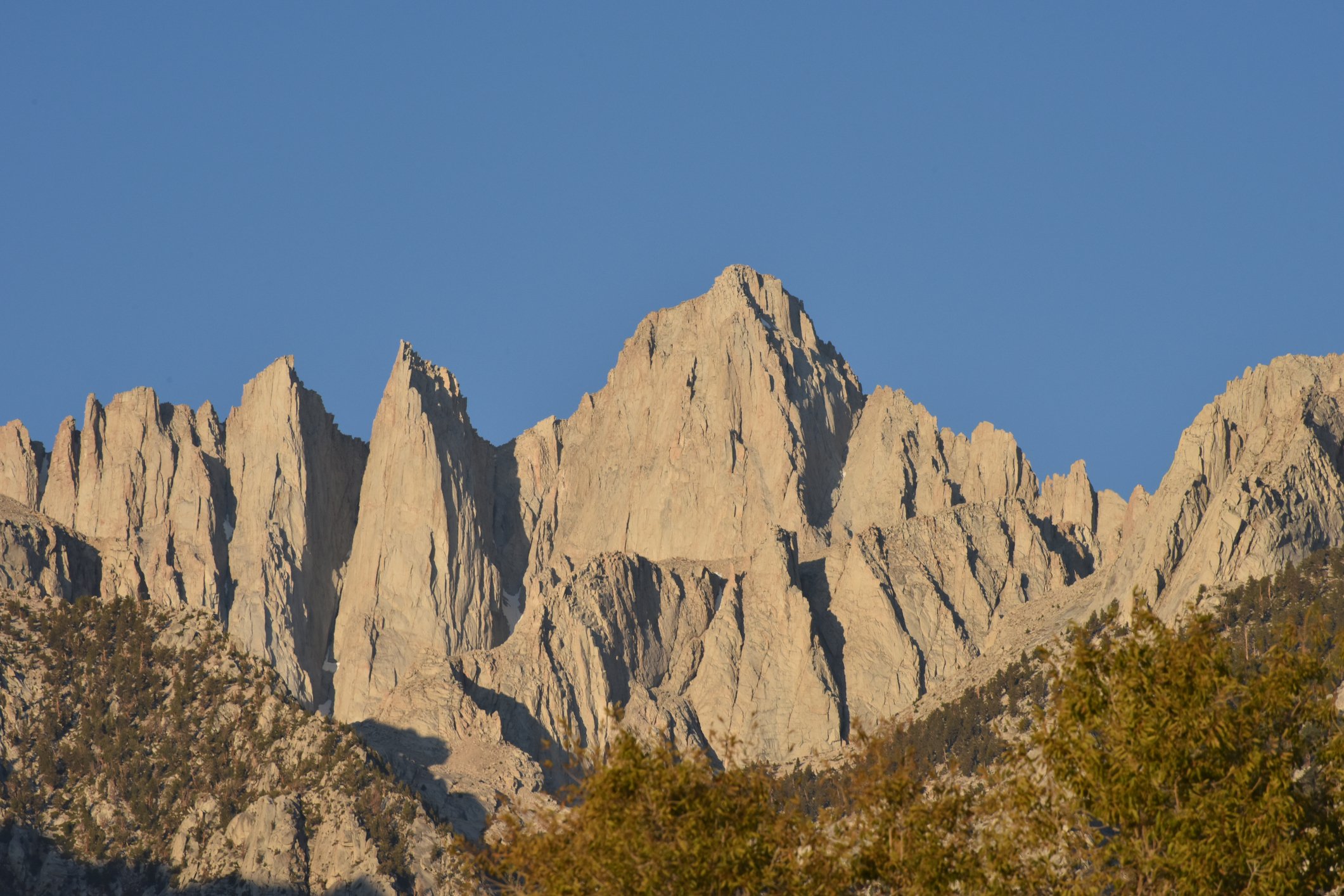
MEET YOUR HOST
Death Valley Running Camp is hosted by Eric Steele, not as a spokesperson, not as a motivator, but as someone who has lived the Badwater course from every angle.
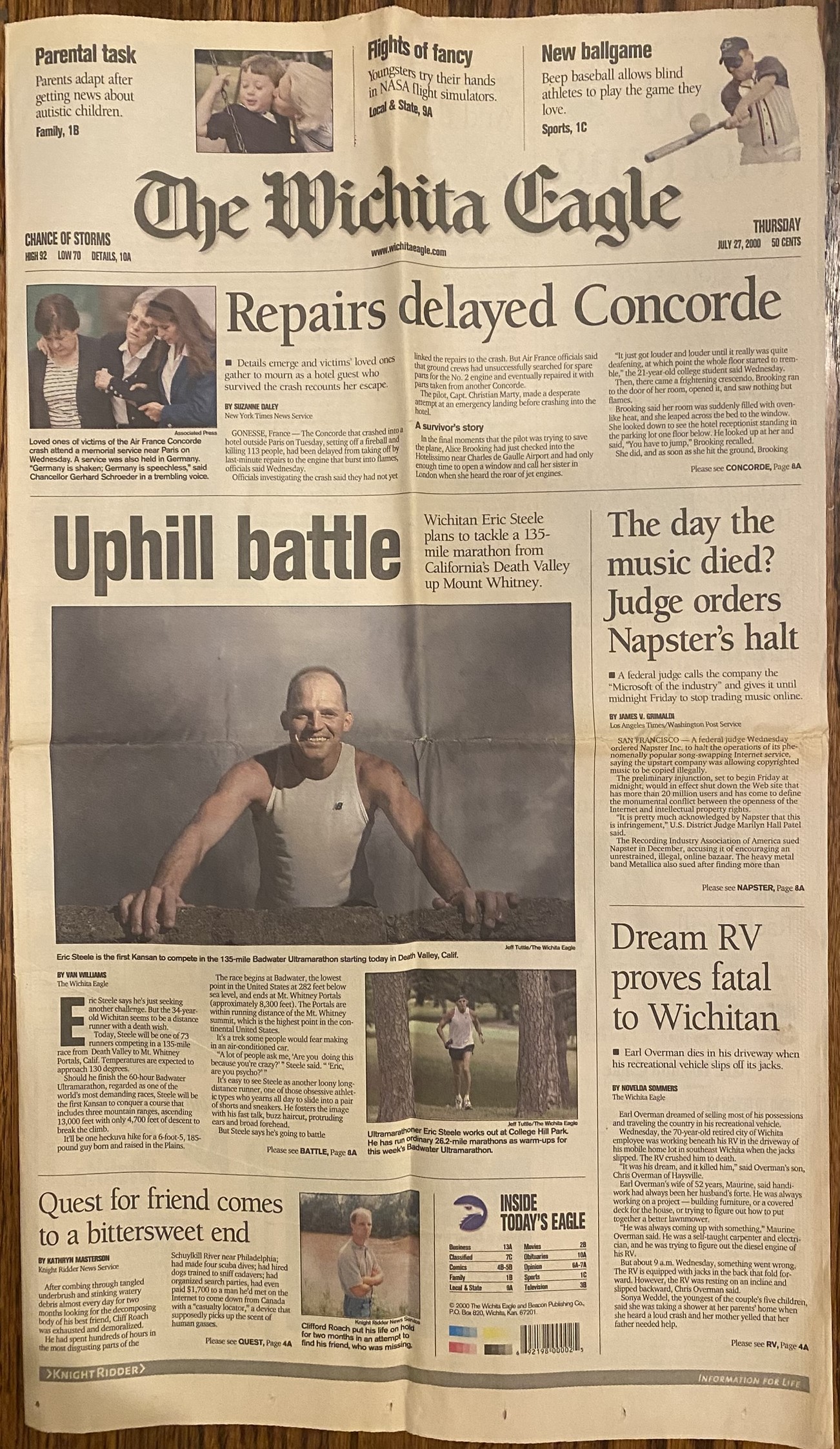
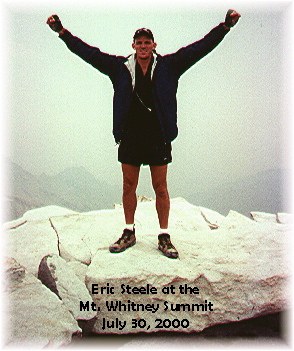
Eric is a 2000 Badwater 135 finisher, along with being the first and only Kansan to complete the full Basin-to-Summit crossing, running from Badwater Basin to the summit of Mount Whitney in a single effort...the way the course was originally envisioned and completed by Al Arnold back in 1977.
[Newspaper front-page feature documenting Eric’s Basin-to-Summit journey appears above]
That crossing was not a one-time exposure to Death Valley.
Eric has paced and crewed extensively at:
-
Badwater 135 (1997, 2019)
-
Badwater Salton Sea (2018, 2019)
Over decades inside the Badwater environment, he has built firsthand experience alongside key individuals who define the event:
-
Marshall Ulrich — most Badwater finishes in history
-
Scott Weber — second most Badwater finishes ever (paced and crewed by Eric in 1997)
-
Ben Jones — known as the “Mayor of Badwater”
-
Chris Kostman — Badwater 135 Race Director
What comes from that experience is not theory or storytelling.
It is real-world execution:
-
Crewing strategies that work on open desert roads
-
Heat management learned under consequence, not controlled conditions
-
Fueling and pacing decisions made when errors compound quickly
-
Judgment developed over years of being responsible for outcomes
This camp exists because that knowledge is hard-earned and transferable only by actually being there.
If you want credentials, they’re easy to list.
If you want understanding of how Death Valley works, how mistakes happen, and how to avoid the ones that matter, that’s what this camp is built to deliver.
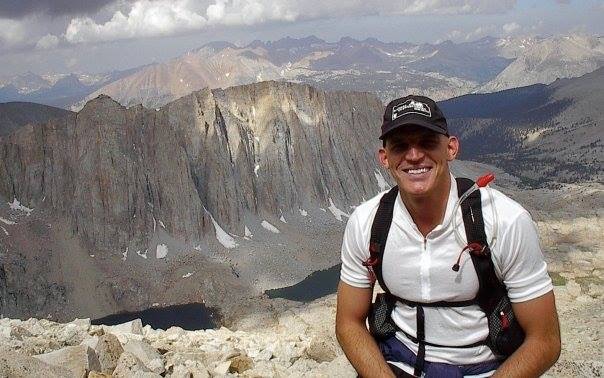
Mt Whitney
1,500 ft. from summit • July 2003
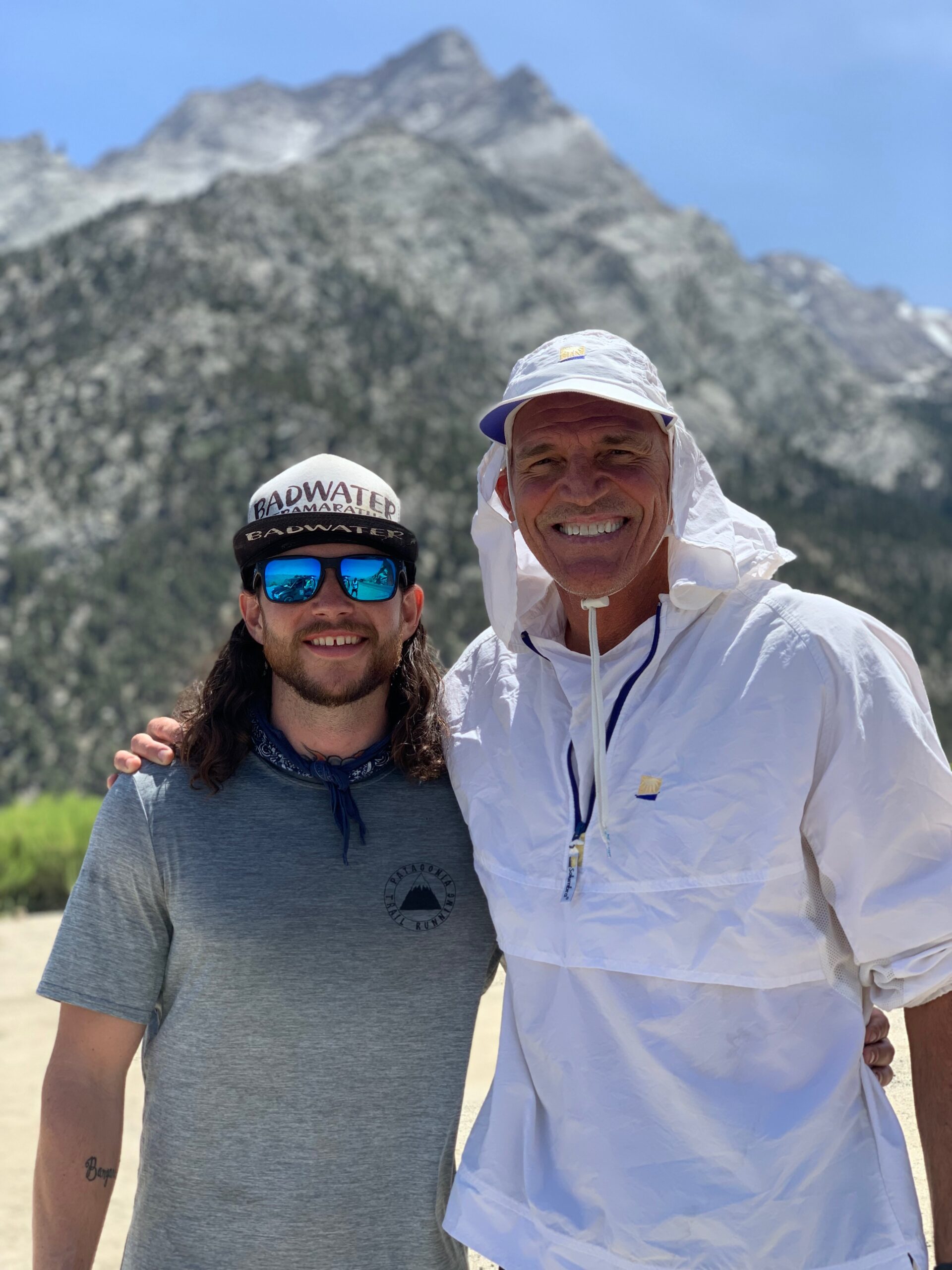
Crewing & Pacing for Mike Coutu
Badwater 135 • July 2019
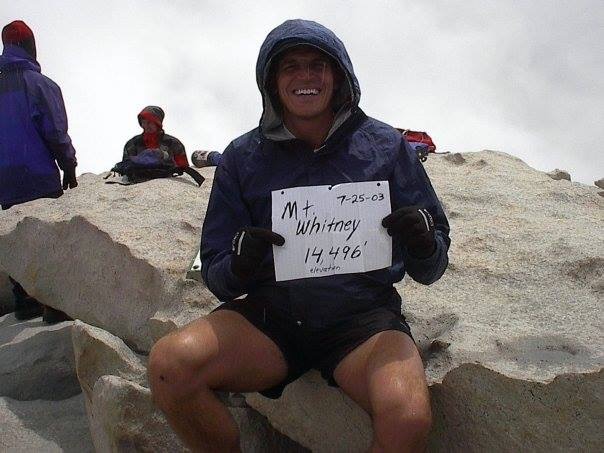
Mt Whitney Summit
14,496 ft. • July 2003
CAMP DATES
Camp I: Sunday, April 12 → Thursday, April 16 • 2026
Camp II: Sunday, April 19 → Thursday, April 23 • 2026
Camp III: Sunday, June 14 → Thursday, June 18 • 2026
Camp IV: Sunday, June 21 → Thursday, June 25 • 2026
ITINERARY
(Applies to all four Death Valley Running Camps)
SUNDAY — ARRIVAL & STAGING (0 miles)
Participants fly into Las Vegas International Airport (LAS).
From the airport, runners will Uber to Enterprise, Nevada (approximately 10 minutes from LAS).
Airport pickup is not provided.
A meet-up location in Enterprise will be announced in advance.
-
Arrival window: 2:00–5:00 PM
-
5:00 PM is a hard departure cutoff
At 5:00 PM, the group departs together for Pahrump, Nevada, where we stay the first night and stage for the course start.
MONDAY — BADWATER BASIN → STOVEPIPE WELLS (42.2 miles)
The camp officially begins on the Badwater course.
-
Start: Badwater Basin
-
Run segment: Badwater Basin to Stovepipe Wells
-
Overnight: Stovepipe Wells
We stay in Stovepipe Wells Monday night — no driving elsewhere after the run.
TUESDAY — STOVEPIPE WELLS → PANAMINT SPRINGS (30.6 miles)
-
Run segment: Stovepipe Wells to Panamint Springs
-
Overnight: Panamint Springs
We stay in Panamint Springs Tuesday night, directly on the course.
WEDNESDAY — PANAMINT SPRINGS → LONE PINE (50.0 miles)
-
Run segment: Panamint Springs to Lone Pine
-
Overnight: Lone Pine
Wednesday night is spent in Lone Pine, setting up for the final climb.
THURSDAY — LONE PINE → WHITNEY PORTAL / RETURN TO LAS VEGAS (11.3 miles)
-
Final run segment: Lone Pine to Whitney Portal
Once all runners complete their final segment, the group departs for Enterprise, Nevada
(approximately a 4-hour drive).
From Enterprise:
-
Participants Uber back to Las Vegas International Airport
-
Recommended flights: early evening or later
WHO THIS IS FOR…AND WHO IT IS NOT
This camp is intentionally specific.
It is built for experienced ultrarunners who want to understand Death Valley by moving through it, not watching it, not simulating it, and not guessing what it might feel like on race day.
This camp is for:
-
Ultrarunners with prior long-distance experience
-
Athletes comfortable running significant mileage on pavement
-
Runners who want firsthand exposure to extreme heat and desert logistics
-
Those considering Badwater, or simply wanting to master one of the most unforgiving environments in endurance sport
-
People who value execution, decision-making, and real-world learning over hype or validation
You don’t need to be fast.
You do need to be honest with yourself.
This camp is not for:
-
First-time ultrarunners
-
Athletes looking for a guided tour or a casual group run
-
Anyone expecting hand-holding, cheerleading, or competition
-
Runners unwilling to adjust pace, ego, or expectations in extreme conditions
This is not about proving anything to anyone else.
It’s about learning what actually works when the environment is in control.

WHAT’S INCLUDED … AND WHAT’S NOT
What’s included:
-
Small-group access (maximum seven athletes)
-
A roving crew vehicle providing essentials access, water/ice, and on-course support
-
Daily point-to-point progression on the actual Badwater course
-
Real-time guidance on pacing, fueling, heat management, and decision-making
-
All lodging during the camp, staying on-course each night in:
-
Pahrump
-
Stovepipe Wells
-
Panamint Springs
-
Lone Pine
-
Lodging is fully coordinated and included.
All rooms are double occupancy (two people per room). Each participant will have their own bed. Private rooms are not available.
Participants will room with a fellow ultrarunner. If you register with a friend or training partner, we will place you together whenever possible.
These lodging locations are limited, difficult to secure, and intentionally chosen to keep the camp moving forward on the actual course...with no backtracking.
Basic, minimal food will be available in the mornings
(for example: simple items such as cereal, milk, bagels, fruit, or similar). This is not a catered experience, and meals are not provided beyond that minimal morning availability. Lodging locations do not allow cooking appliances, and expectations should reflect that reality.
Participants are responsible for their own dinners each night, as well as their individual fueling needs during the day. All lodging locations have on-site or nearby restaurants, and runners will handle their evening meals accordingly. We will often eat together as a group, but there are no set meal plans or provided dinners.
Fueling during run segments is the responsibility of each participant. The crew vehicle provides access and support, but runners must bring and manage their own nutrition, powders, and personal fueling preferences. You are responsible for your movement & essentials. Guidance is there when it matters.
THE REAL COST OF DOING THIS ON YOUR OWN
If you’ve ever looked seriously at Badwater, you already know this part gets glossed over.
The entry fee is just the beginning.
That number does not include:
-
A mandatory support crew
-
Crew travel
-
Lodging across multiple towns
-
A vehicle allowed in Death Valley
-
Fuel
-
Food
-
Or the cost of convincing friends or family to give up nearly a week of their lives in extreme heat
When runners start adding it up, the reality sets in quickly.
Once you factor in crew expenses, transportation, hotels in remote locations like Stovepipe Wells and Panamint Springs, and the logistics of moving point-to-point across Death Valley, the total cost commonly reaches several thousand dollars (easily) and potentially well beyond...before you’ve even toed a starting line.
And that’s assuming:
-
Nothing goes wrong
-
Your crew knows what they’re doing
-
You’re able to rehearse the course at all
Most runners never get that far.
WHAT THIS CAMP CHANGES
The Death Valley Running Camp removes the most difficult and expensive parts of the equation.
You don’t need to:
-
Assemble a crew
-
Rent or insure a vehicle
-
Coordinate lodging across four towns
-
Gamble on logistics you’ve never tested
-
Or ask friends to learn Death Valley on the fly
The route is planned.
The lodging is secured.
The support is in place.
The mistakes have already been made...and learned from.
What you’re paying for is not just access.
You’re paying to compress years of uncertainty into a single, controlled experience on the actual course.
Latest search from AI below:

FREQUENTLY ASKED QUESTIONS
How does pacing and support actually work out on the course?
This camp operates with a single roving crew vehicle, not individual pacing vehicles glued to runners. With a group of seven, athletes are loosely paired by ability and experience. Support is provided at regular intervals, typically every 2–4 miles, depending on heat, terrain, and conditions. This mirrors how real Badwater pacing works. Crews stage ahead, wait, and provide support when it matters, not constant leapfrogging. You will not be left alone for extended stretches without access to water, guidance, or problem-solving support.
What pace do I need to be able to maintain to participate?
This camp requires the ability to maintain a minimum average pace of 15 minutes per mile (4 miles per hour). That pace applies across all days and all sections. If you move faster than this pace, that’s fine. If you cannot consistently maintain a 15-minute-per-mile average, this camp is not a good fit. This expectation exists to keep the camp moving safely, predictably, and within daylight and logistical limits.
What exactly does the crew vehicle provide during the day?
The crew vehicle is a working support platform.
Primary on-course support includes:
-
Plenty of water
-
Limited ice, depending on availability and conditions
-
Assistance with fueling logistics, essentials, and decision-making
-
Oversight from someone who knows how this environment actually works
Everyone fuels differently. Athletes are expected to bring their own gels, powders, and nutrition. If you use a specific hydration mix, you bring it and it will be supported.
Can I sit in the van to cool off?
No. This is not an air-conditioned recovery lounge, and the crew vehicle is not used to escape the environment. Cooling strategies are managed on the road, the same way they are during Badwater through pacing, fluids, fueling, experience, and smart decisions.
How often will I have access to water and support?
Support stops are frequent and predictable, typically every 2–4 miles, adjusted as needed for heat and conditions. This is not a situation where you’re sent down the road for hours without support. At the same time, this is not constant hand-holding.
What about bathrooms during the day?
This is a real advantage of how this camp is structured. The crew vehicle is not a passenger van, and it is not cramped. You can stand up inside it.
In addition:
-
A dedicated porta-potty will be on board
-
The van has a built-in restroom for urination only
-
Runnerss, including women, will have access to a proper sit-down option during the day
This removes one of the more "fun" logistical realities of long desert days and allows athletes to manage basic needs without improvising on the side of the road.
How much gear should I bring?
Pack extremely light. This is critical. Every morning, we pack up and leave each location. Nothing gets left behind. All of your gear moves forward every day.
You should plan on:
-
One primary bag
-
Essential running gear
-
Fueling supplies
-
Minimal evening clothing
There is limited space. Overpacking creates problems for everyone. This camp is not compatible with excess gear, duplicate bags, or “just in case” packing.
Are meals included?
No, with one exception. Minimal food may be available in the mornings (for example: cereal, milk, fruit, or similar). This is not a catered experience. Evening meals are on your own. Each overnight town has dining options. Group dinners often happen naturally, but participation is optional. Athletes are also responsible for their own fueling during run segments.
Can I cook or use appliances in the hotel rooms?
No. Several lodging locations along the route have strict rules due to infrastructure limitations. Hot plates, cookers, and similar appliances are not allowed. Plan accordingly.
How slow can I go and still be appropriate for this camp?
This is not about speed, it’s about forward progress. Runners must be able to maintain a minimum of an average pace of 15 minutes per mile far all days on the course.
What happens if I need to stop or pull the plug for the day?
Stopping is always an option. This camp is not about forcing miles at all costs. Decisions will be made based on conditions, health, and judgment. The goal is understanding how to move through Death Valley intelligently, not grinding yourself into the ground.
Can friends, partners, or spectators attend?
No. This camp is designed for participants only. Additional vehicles, spectators, or outside crew are not part of the structure.
Is this camp safe?
Death Valley is never “safe” in a casual sense. What this camp provides is experienced oversight, structured logistics, and real-world decision-making support from someone who understands the environment deeply. Athletes are expected to arrive prepared, honest, and adaptable.
What happens if the crew vehicle has a mechanical issue?
Death Valley is a remote, unforgiving environment. Anyone who has spent time here understands that delays can happen. The crew vehicle is well-maintained, equipped, and covered for roadside assistance. In the event of a mechanical issue, established recovery protocols are followed. The camp is structured so runners are not isolated miles ahead without awareness or support. Athletes are paired, support intervals are conservative, and decision-making prioritizes safety and situational awareness. This is not a guided tour with instant solutions. It is a real desert environment, approached with experience, planning, and respect.
Is this a substitute for Badwater 135?
No. This camp is not a race, not an entry guarantee, and not affiliated with, endorsed by, or operated in partnership with the Badwater 135 Ultramarathon, AdventureCORPS, or its race directors.
It is an independent educational and training experience designed to teach the course, environment, and execution required to succeed without the pressure of cutoffs or competition.
PRICE & REGISTRATION
SECURING YOUR SPOT
Each Death Valley Running Camp is limited to seven athletes.
Spots are secured on a first-come, first-served basis.
CAMP PRICE
The total cost of the Death Valley Running Camp is $1,800.
You may pay in full, or secure your spot with a $400 non-refunable deposit payment, which is applied toward the total camp cost.
This is a true all-inclusive price. All applicable taxes, processing fees, and merchant fees are included. There are no additional charges added at checkout.
WHAT HAPPENS AFTER YOU REGISTER
Once you secure your spot:
-
You’ll receive a confirmation email with next steps
-
You’ll be invited into a private Death Valley Running Camp member area, which serves as the central hub for camp communication and preparation
-
Camp updates, guidance, and preparation materials will be posted there, including:
-
packing recommendations
-
fueling and hydration considerations
-
pacing expectations
-
logistical reminders
-
-
You’ll have clear channels to ask questions and get clarification as needed, including direct communication when appropriate
This camp begins well before you run Death Valley.
WHAT YOUR REGISTRATION INCLUDES
-
Participation in the Death Valley Running Camp on your selected dates
-
Small-group access (maximum seven athletes)
-
Roving crew support throughout the week
-
Lodging each night along the course:
-
Pahrump
-
Stovepipe Wells
-
Panamint Springs
-
Lone Pine
-
-
Point-to-point progression on the actual Badwater course
-
Real-time guidance on pacing, fueling, heat management, and decision-making
-
Pre-camp communication and preparation support
PAYMENT, CANCELLATIONS & REFUNDS
The following policy applies to all Death Valley Running Camps.
Non-Refundable Deposit Amount
-
$400 of every registration is a non-refundable deposit, regardless of whether you pay in full or secure your spot with this initial deposit
-
This amount represents the non-refundable deposit portion of your registration and applies to all participants
Refund Policy
-
30 days or more before camp start:
Any amount paid beyond the $400 non-refundable deposit will be refunded -
Less than 30 days before camp start:
No refunds will be issued
Unforeseen Circumstances / Organizer Cancellation
In the event the camp is canceled due to unforeseen circumstances beyond the control of the organizer (for example: severe weather, road closures, natural disasters, or other “act of God” situations), all payments will be refunded in full, including the $400 deposit amount.
Travel Insurance
Because this camp involves travel, fixed logistics, and limited capacity, travel insurance is strongly recommended. Participants are encouraged to purchase third-party travel insurance to protect against unexpected changes or personal circumstances.
SELECT YOUR CAMP DATES & REGISTER
Locking In Your Spot (and Your Dates)
Each Death Valley Running Camp is limited to seven runners.
We’re offering four separate camp sessions, not to scale this bigger, but to give serious runners flexibility. People have different schedules, different obligations, and different windows where this kind of commitment actually works.
That said, each camp fills independently.
If you have specific dates you want, it’s important to act accordingly.
To make that easier, a $400 non-refundable deposit is available to lock in your spot and your preferred camp dates immediately. This is not a waitlist or a soft hold, once a camp reaches seven participants, registration for that session closes.
You may also pay the full $1,800 upfront if you prefer.
The deposit payment exists so you don’t lose the dates that work best for you while finalizing the rest of your plans.
Waiting until you’re ready to pay in full is the fastest way to miss your preferred camp dates.
Choose your camp session below to secure your spot now:




STILL HAVE QUESTIONS? CALL ME.
If you’ve read this page and you’re still on the fence, pick up the phone and call me.
I’m happy to talk through real questions...logistics, expectations, whether this camp is actually a good fit for you, or whether it’s not. I’d much rather have a straight conversation now than have the wrong person show up in Death Valley.
That said, if you’re calling to ask something that’s clearly spelled out on this page, I’ll probably tell you exactly that. This camp requires people who read, think, and make decisions deliberately. If you’re looking for clarity, honesty, and a real conversation about what this experience is and isn’t, I’m here.
Eric Steele
📞 316-351-8409
CHOSEN HELL
A Journey Through the Valley of Life
An essay I wrote in 2000 after running the Badwater 135 and continuing on to the summit of Mount Whitney.
Read Here

Copyright © 2026 Death Valley Running Camp
Powered By Epic Ultras
Death Valley Running Camp is not affiliated with, endorsed by, sponsored by, or in any way officially connected to Badwater® Ultramarathon, Badwater® 135, or AdventureCORPS®, Inc.